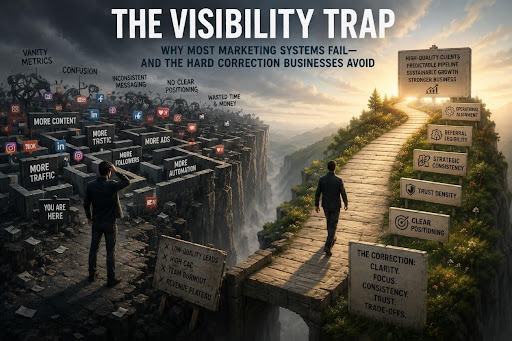
The Visibility Trap
The Visibility Trap
Why Most Marketing Systems Fail
And the Hard Correction Most Businesses Avoid
1. Opening Story (Cliffhanger)
The founder had numbers everywhere.
Website traffic was up 41%.
LinkedIn impressions had doubled in six months.
The company had hired a marketing agency, rebuilt the website twice, launched webinars, added CRM automation, published weekly content, and spent more money on “brand visibility” than at any point in the company’s history.
Yet pipeline quality was deteriorating.
Sales conversations were becoming harder, not easier.
The team quietly started blaming “the market.”
Then came the meeting that exposed the real problem.
A long-term referral partner said something nobody in the company had been willing to say out loud:
“I see your content constantly. I still can’t clearly explain what you actually do differently.”
The room went quiet.
Not because the statement was inaccurate.
Because everyone immediately knew it was true.
The company had mistaken marketing activity for market clarity.
And worse:
the system itself was designed to reward motion, not understanding.
The dangerous part was that from the outside, the business looked disciplined.
Internally, it was becoming strategically incoherent.
The correction required more than better marketing.
It required subtraction.
And nobody wanted to make the trade-offs that would expose what was actually not working.
2. Big Question
Why do so many businesses increase marketing activity while simultaneously decreasing market clarity?
Or more directly:
Why do intelligent companies build marketing systems that generate visibility but weaken trust, positioning, and conversion over time?
3. Limiting Belief
One of the most expensive beliefs in modern business is this:
“Consistent marketing activity automatically produces business growth.”
It sounds disciplined.
Responsible.
Even data-driven.
But in practice, this belief often creates fragile businesses drowning in tactical output and strategic confusion.
The hidden assumption underneath the belief is rarely examined:
If we produce enough visibility, demand will eventually follow.
Sometimes it does.
But often visibility amplifies confusion faster than it amplifies trust.
This is especially dangerous in professional services, consulting, coaching, advisory, and expertise-based businesses where buyers are not merely evaluating information.
They are evaluating judgment.
Most businesses do not lose trust because they lack competence.
They lose trust because the market cannot easily determine:
what they actually stand for,
who they are truly for,
what they intentionally exclude,
and why their approach matters.
In other words:
they optimize reach before coherence.
The result is predictable:
high activity,
inconsistent lead quality,
weak referrals,
confused positioning,
increasing marketing fatigue,
and growing dependence on volume.
The tragedy is that many businesses interpret this as a need for more marketing.
Usually the opposite is true.
4. Shift to the Correct Belief
The businesses that sustain long-term demand rarely win because they market more.
They win because they reduce interpretive friction.
Customers do not reward businesses for effort.
They reward businesses that are easiest to understand, easiest to trust, and easiest to refer.
That requires a fundamentally different operating assumption:
Marketing is not primarily a visibility problem.
It is a clarity and positioning problem.
Peter Drucker repeatedly emphasized that the purpose of business is to create a customer, not merely activity (Drucker, 2006).
Michael Porter argued that strategy requires deliberate trade-offs, not generalized competence (Porter, 1996).
Yet many marketing systems violate both principles simultaneously.
They attempt to:
appeal to everyone,
publish everywhere,
say everything,
imitate trends,
and maximize engagement metrics detached from strategic positioning.
The consequence is not just inefficiency.
It is erosion.
The market gradually loses the ability to categorize the business meaningfully.
And when positioning becomes unclear, acquisition costs rise because trust must now be rebuilt repeatedly from scratch.
Strong marketing systems reduce uncertainty.
Weak marketing systems increase informational noise.
That distinction matters more than most companies realize.
5. The Key Framework: The Signal-to-Noise Marketing Framework
Most failing marketing systems suffer from one underlying structural problem:
They reward output volume instead of signal strength.
The correction is not primarily tactical.
It is architectural.
The Signal-to-Noise Marketing Framework evaluates marketing through five filters:
1. Positioning Clarity
Can the market quickly explain:
who you help,
what problem you solve,
what you reject,
and why your approach differs?
If not, visibility compounds confusion.
Distinctiveness precedes scale.
Not the other way around.
2. Trust Density
How much real trust is created per interaction?
Most content creates awareness.
Very little creates conviction.
Trust density increases when communication demonstrates:
judgment,
specificity,
restraint,
pattern recognition,
and clear thinking under complexity.
This is why thoughtful operators often outperform louder competitors over time.
3. Strategic Consistency
Does the business communicate from a stable strategic center?
Or does messaging shift weekly based on trends, algorithms, or engagement metrics?
A scattered marketing identity creates hidden instability.
Customers subconsciously associate consistency with operational reliability.
4. Referral Legibility
Can other people easily explain your value to others?
Many businesses unintentionally create “referral friction.”
Their offer may be intelligent but difficult to summarize.
Businesses grow faster when:
the problem is recognizable,
the positioning is memorable,
and the value is transferable conversationally.
If referral partners cannot explain what you do in two sentences, growth slows.
5. Operational Alignment
Can the business operationally support the demand it creates?
Many marketing systems fail because operational reality contradicts brand promises.
This creates fragility.
Andy Grove warned that operational discipline matters most under pressure, not during ideal conditions (Grove, 1996).
Marketing systems that outrun operational clarity eventually collapse trust internally and externally.
What This Framework Intentionally Leaves Out
It intentionally deprioritizes:
vanity metrics,
follower counts,
engagement obsession,
trend participation,
and performative visibility.
Not because those things never matter.
But because businesses frequently optimize secondary indicators while weakening primary trust mechanisms.
The framework asks a harder question:
Does this communication increase clarity and trust among the right people?
If not, more volume rarely solves the problem.
6. Case Study / Social Proof
During the early 2000s, Southwest Airlines demonstrated something many modern marketing systems ignore.
The company did not attempt to become everything to everyone.
It accepted painful trade-offs deliberately.
Southwest chose:
limited service complexity,
operational simplicity,
specific route structures,
standardized aircraft,
and a distinct customer promise.
Competitors often perceived this as limitation.
In reality, it created strategic coherence.
Porter later highlighted Southwest as an example of strategy rooted in fit and trade-offs rather than isolated tactics (Porter, 1996).
The relevance to marketing is profound.
Southwest’s strength was not merely branding.
It was systemic alignment.
The messaging matched:
operations,
customer expectations,
economics,
and strategic identity.
Contrast this with many modern businesses that:
promise premium positioning,
operate reactively,
produce generic messaging,
and pursue broad-market relevance simultaneously.
The market senses the inconsistency even when the business does not.
Another example emerged during the rapid rise of direct-to-consumer brands in the 2010s.
Many companies initially grew through aggressive paid acquisition.
But when advertising costs increased and platform algorithms changed, weak positioning became exposed.
Businesses built primarily on traffic arbitrage discovered they had not built durable trust systems.
They had built dependency systems.
The distinction mattered once conditions changed.
Taleb’s work on fragility applies here:
systems optimized for favorable conditions often break under volatility (Taleb, 2012).
Many marketing systems are fragile because they depend on:
continuous stimulation,
constant content production,
rising ad spend,
and platform stability.
Durable systems rely more heavily on:
positioning,
reputation,
referrals,
clarity,
and trust transfer.
Those systems compound differently.
7. Outro Story (Resolution)
Three months after the uncomfortable referral meeting, the founder made a decision the team initially resisted.
They stopped producing nearly 70% of their marketing output.
No daily motivational content.
No trend participation.
No broad-market messaging.
No generalized “thought leadership.”
Instead, they rebuilt around a smaller strategic center.
The company narrowed:
who they served,
what problems they addressed,
what language they used,
and what opportunities they would intentionally decline.
At first, visibility metrics dropped.
Internally, people became nervous.
But something else happened quietly.
Sales conversations shortened.
Referral quality improved.
Prospects arrived with clearer expectations.
The business was no longer trying to persuade the market constantly.
It was becoming recognizable to the right people.
Not larger.
Sharper.
The real correction was not increased marketing sophistication.
It was reduced strategic noise.
And once the noise dropped, decisions became easier throughout the company — not only in marketing.
Because clarity scales operationally.
Confusion does too.
8. Homework Assignment (One Action)
For the next seven days, do not create new marketing content.
Instead, perform a Signal Audit.
Ask:
Can someone explain what we do in two sentences?
What audience are we unintentionally attracting?
What are we communicating that we cannot operationally sustain?
Which marketing activities create visibility but not trust?
What would we stop publishing if clarity mattered more than volume?
Then remove one major source of strategic noise.
Not optimize it.
Remove it.
The goal is not immediate growth.
The goal is to expose whether the business has built a marketing engine — or merely a marketing treadmill.
9. APA Citations
Collins, J. (2001). Good to great: Why some companies make the leap... and others don't. HarperBusiness.
Drucker, P. F. (2006). The practice of management. HarperBusiness. (Original work published 1954)
Grove, A. S. (1996). Only the paranoid survive: How to exploit the crisis points that challenge every company. Currency Doubleday.
Porter, M. E. (1996). What is strategy? Harvard Business Review, 74(6), 61–78.
Taleb, N. N. (2012). Antifragile: Things that gain from disorder. Random House.
Christensen, C. M. (1997). The innovator’s dilemma: When new technologies cause great firms to fail. Harvard Business School Press.
Newport, C. (2016). Deep work: Rules for focused success in a distracted world. Grand Central Publishing.
Godin, S. (2005). All marketers are liars: The power of telling authentic stories in a low-trust world. Portfolio.
Horowitz, B. (2014). The hard thing about hard things: Building a business when there are no easy answers. HarperBusiness.
